What clients check before booking a discovery call is rarely a single moment of conscious judgment. A quiet evaluation is already underway from the first time they encounter your name, and by the time they reach out, the decision is largely made. Understanding exactly what they look at, in what sequence, and what each element communicates, is one of the most underused advantages in a coaching or consulting business.
The seven-second homepage test
A potential client lands on your website with a single question forming in the back of their mind: is this person for someone like me? They are not looking for your full biography. They are not reading your methodology page. They are scanning, and the decision to stay or leave happens in approximately seven seconds. Most coaching and consulting homepages fail this test, not because they lack information but because they lead with the wrong information at the wrong moment.
The most common mistake is positioning the biography at the top of the page. A biography communicates what matters to you. What the visitor needs to see first is what matters to them: a clear statement of who you work with, what problem you solve, and what result they can expect. Everything else is secondary. A headline that describes your methodology rather than the outcome it produces tells the reader nothing useful at the moment they most need clarity.
Visual presentation is part of this judgment, not separate from it. A page that loads slowly, looks dated relative to what the visitor has seen of you on other platforms, or lacks visual intention creates a dissonance that is difficult to recover from further down the page. This does not require an elaborate or expensive design. It requires a deliberate one. A page that is visually considered and communicates clearly will hold attention where a cluttered page loses it. The test is not whether you like your homepage. The test is whether a complete stranger who knows nothing about you can answer those three questions within seven seconds of arriving.
Social proof that actually converts
Social proof is among the most decisive items in what clients check before booking a discovery call, and most coaches present it in a way that fails to do the job it is there to do. There is a significant difference between social validation and social proof, and most coaches and consultants are relying on the first while believing they are delivering the second. Social validation is evidence that people like you. Social proof is evidence that someone in a situation like your potential client’s situation got the result they want. The first is pleasant to have. The second is what actually moves decisions.
A testimonial that says working with you was incredible and they would recommend you unreservedly offers social validation. It confirms you are well regarded. It does not confirm that you are effective for the specific problem your potential client is trying to solve right now. The testimonials that convert are specific about the before: what situation the client was in, what they had tried, what was not working. They are specific about the process: what working with you was like, what changed in how they thought about the problem. And they land on a concrete, named outcome.
Number matters far less than quality. A single detailed, outcome-oriented testimonial from someone whose profile matches your ideal client will carry more persuasive weight than fifteen generic endorsements. If your current testimonials are vague, the solution is not to gather more of them. It is to return to past clients and ask better questions. Ask what the situation was before you worked together. Ask what specifically changed. Ask what they would say to someone in a similar position who was deciding whether to work with you. Those prompts produce the kind of specificity that converts.
What visual inconsistency costs you
Before a potential client considers booking a call, they will typically encounter you in at least three separate contexts: a social media platform, a referral or search result, and your website. If each of those experiences looks and feels different from the others, the cumulative effect is a quiet erosion of confidence. Not distrust, exactly. Something more subtle and more damaging: a sense that the professional presented in one context is not quite the same as the professional encountered in another.
Visual inconsistency communicates unintentionality. And unintentionality is a poor signal to send at the moment a potential client is deciding whether to invest in you. Your profile photograph, your color palette, your typography, and your overall visual tone should tell the same story wherever a potential client finds you. When they do, the cumulative impression is coherence, which reads as confidence and reliability. When they do not, the impression is fragmentation, which introduces doubt at precisely the moment you need to be removing it.
This is one of the areas where established coaches and consultants most consistently underestimate the problem. The work is strong. The results are genuine. But the visual presentation has evolved organically over several years, adding a new profile here and updating a website there, and the gaps have accumulated. From the inside, every decision has context. From the outside, only the result is visible. And the result is a brand that does not cohere.
Content as a proxy for thinking
Before someone commits significant budget to working with a coach or consultant, they want to understand how you think. Not just what you know, but how you approach problems, what framework you apply, and where your perspective diverges from the conventional wisdom in your space. Content is the primary mechanism by which this evaluation happens. And generic content, content that could have been written by anyone working in your category, actively undermines this evaluation because it provides no basis for differentiation.
The content that builds genuine trust takes a position. It reflects a specific perspective on a problem your ideal client is experiencing. It is willing to say that one approach is better than another, or that a widely accepted practice is actually causing more harm than good, or that the thing most people focus on is not the thing that matters most. This kind of content reveals something real about how you think, and that is what a potential client is looking for when they scroll your feed before deciding whether to request a call.
For many established coaches and consultants, this is the area with the most untapped potential. The intellectual infrastructure is there. The frameworks are developed. The perspective is genuine and hard-won. But the public-facing content does not reflect any of it in a way that is distinctive or useful to a potential client trying to make a decision. The result is a strong practitioner who is invisible in the market, which is a problem with a practical solution.
Booking friction: the last barrier between interest and action
All four of the above checkpoints can be handled well, and the conversion can still fail at the final moment if the path from interest to action is unclear or unnecessarily complicated. Booking friction is one of the most consistently overlooked problems in coaching and consulting businesses, and it costs real revenue in ways that are almost entirely invisible to the business owner.
A potential client who has real interest in working with you should be able to book a discovery call, or at minimum submit a meaningful inquiry, in under sixty seconds. If they have to hunt for a contact link, navigate to an external booking system without any indication it is coming, complete a lengthy intake questionnaire before anything has been agreed, or wait for an email response before the next step can happen, a significant percentage will not complete that process. Not because they are not interested. Because the friction required exceeds the threshold they are willing to cross at that particular moment. Interest without a clear path to action is interest that dissipates.
The solution is visibility and consistency. The path to booking should be present on your homepage, accessible from your social media profiles, and consistent at every point where someone encounters your work. The instruction should be simple enough that no additional explanation is needed. The mechanism itself should function without friction. When this is done well it becomes invisible, which is exactly what you want. When it is done poorly, it is the last thing a potential client experiences before deciding to look elsewhere.
What Clients Check Before Booking a Discovery Call: Running the Audit on Yourself
Most established coaches and consultants have never audited their own digital presence from the outside in. They are too familiar with it. They see the intention behind every decision and the reasoning behind every design choice rather than the accumulated reality of what a stranger encounters when they arrive without context. The five checkpoints above give you a working framework for running that audit yourself, but they are a starting point rather than the complete picture.
The full scope of what clients check before booking a discovery call maps to seven distinct areas: homepage clarity, visual consistency, social proof quality, booking friction, client journey structure, platform coherence, and the automation infrastructure that handles the process once someone expresses interest. Each area has a different impact on conversion, and the gaps in different areas require different types of intervention. Knowing which areas are working and which are creating drag changes what you prioritize and where you invest.
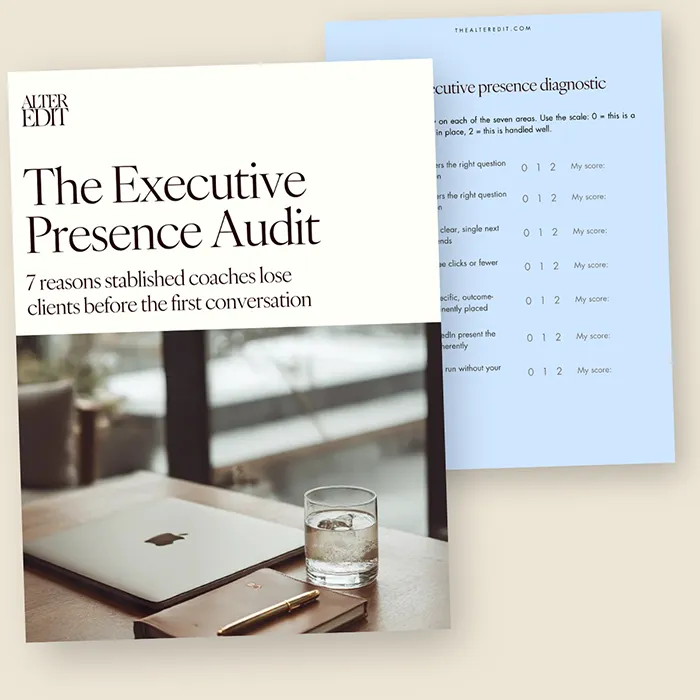 The Executive Presence Audit is a free diagnostic built to close this gap. It covers all seven areas with a structured self-assessment scoring framework, so you can evaluate your own presence accurately, identify where the specific gaps are, and understand the likely impact of each on your conversion rate. Download the Executive Presence Audit here.
The silent evaluation your potential clients run on you is already happening. The question is only whether the evidence they find reflects the quality of the work you actually deliver.