Most advice on how to measure productivity starts with time. Hours logged, tasks ticked, streaks kept. If you run a small business, you already know where that leads. Long weeks that feel full and produce little, and a slow slide toward burnout that only shows once you are already tired.
This guide shows you how to measure productivity in a way that counts the one resource you actually spend each day: energy. It takes four minutes, needs no app, and within a few weeks it shows you which days are worth repeating.
Why hours are the wrong way to measure productivity
An eight hour day feels productive. A three hour day feels lazy. Yet you have had long days that produced almost nothing, and short days that moved the whole business forward. Time tells you how long you worked. It says nothing about what that work was worth, or what it cost you.
Tony Schwartz and Catherine McCarthy made the case in Manage Your Energy, Not Your Time in the Harvard Business Review. Time is fixed. Energy is not. A focused morning costs far more than an afternoon of email, and it is worth far more. When energy runs low, extra hours do not add output. They add mistakes, rework and the feeling of being permanently behind.
Measure output against energy
A more useful way to measure productivity is to compare what you produced with what it took out of you. I call this your Rate of Return.
Rate of Return = Output ÷ Energy
Energy is how much you had to give that day, scored from 1 (running on empty) to 5 (a full tank). Output is how much of what matters moved forward, scored from 1 (very little) to 5 (your best kind of day). A 3 is a good, ordinary day on either scale.
The ratio is the point. Output alone rewards running yourself into the ground. Energy alone rewards resting. Dividing one by the other shows the days you did good work without spending more than you had.
How to measure productivity in four minutes a day
- Each evening, score your Energy from 1 to 5.
- Score your Output from 1 to 5.
- Divide Output by Energy. That is your Return for the day.
- On Sunday, total the week’s Energy and the week’s Output, then divide the totals. Do not average the daily numbers.
Score at roughly the same time each evening, and score honestly rather than hopefully. The habit matters more than the precision.
Free printable tracker
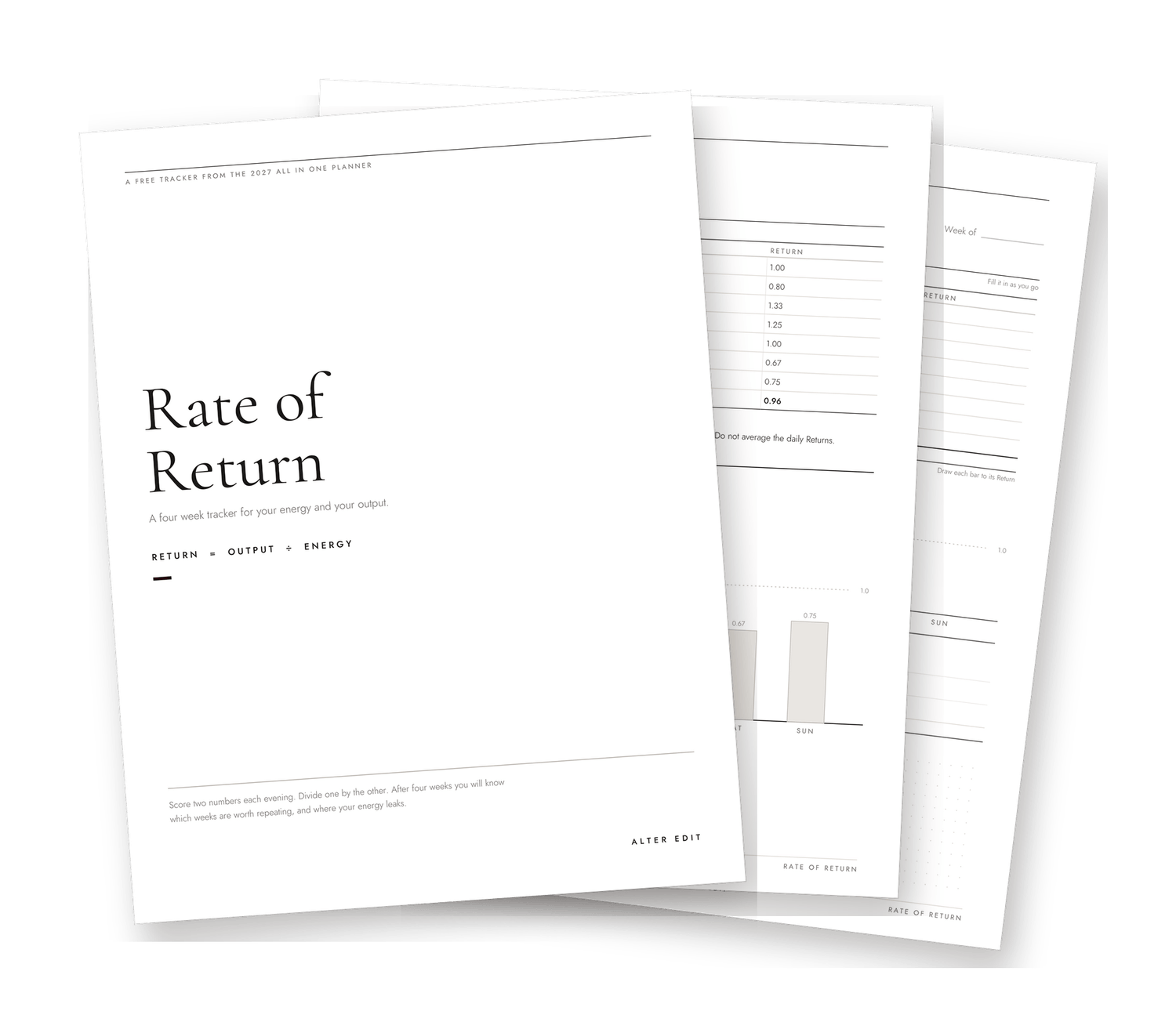
Start tonight with the Rate of Return tracker
A scoring guide, a worked week, four weekly trackers and a four week review. Printable in US Letter and A4.
What your number tells you
Above 1.0. You produced more than you spent. Find what made that possible and protect it.
0.8 to 1.0. On pace. A normal range. Hold the rhythm and watch the trend.
Below 0.8. Something leaked. Name the leak, then fix it.
The four leaks behind a low score
When a day scores low, the cause is almost always one of four things.
Sleep. You started the day already in debt. Give your first hour to work you can do on autopilot, and move your hardest task later.
Scope. The task grew while you were doing it. Before you start, write one line describing what done looks like, and stop when you reach it.
Interruptions. The work kept being broken into pieces. Book one 90 minute block with your phone in another room and email closed, then compare that day’s score.
The wrong work. Busy, but not on what moves the business. At 10am, ask whether what you are doing is the thing that matters this week. If not, swap it.
Turn a week of scores into a better week
Knowing how to measure productivity is only useful if it changes next week. This review takes ten minutes on a Sunday.
Find your best day. Circle your highest Return and note what time you started, what you did first and what did not happen.
Protect it. Give your most important task next week the same conditions. Same time of day, same first task, same quiet. Put it in your calendar now.
Remove one thing. Circle your lowest Return and the leak behind it. Remove one cause. One meeting, one late night, or one task that is not yours to do.
Repeat this every week and your weeks start to look like your best ones, not your busiest ones.
Measuring productivity across a whole year
Four weeks of scores shows you a pattern. A full year shows you how you actually work, quarter by quarter. Plan in thirteen week blocks, with one priority for the business and one for home, and review each week against your Rate of Return. When your best weeks line up with your priorities, you are on course.
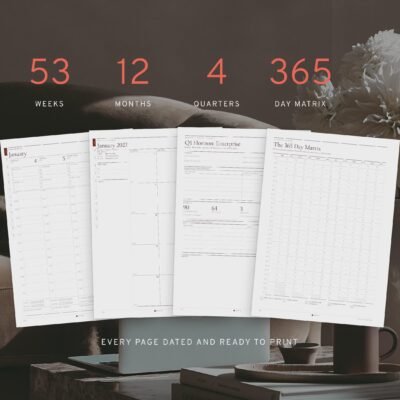
The All in One Planner is built around this rhythm, with the Rate of Return in every week, quarter planning pages and dated pages for your business and your home in one binder.
Start tonight
You do not need a new app or a new routine to measure productivity well. You need two honest scores each evening and ten minutes on a Sunday. The free tracker gives you everything to start.
Find the weeks worth repeating
Free Rate of Return tracker. Four minutes a day. Printable in US Letter and A4.