Most established coaches and consultants believe their brand is more consistent than it actually is. They have a color they use most of the time. They have a logo. They have a general sense of the professional image they want to project. But if you were to follow the actual journey a potential client takes when researching them, platform to platform, touchpoint to touchpoint, a different picture would emerge. Not one of a coherent, considered professional presence. One of a business that has grown organically without a unifying visual system, and where the gaps have been accumulating in silence.
What brand inconsistency actually is
Brand inconsistency is not the absence of design. Every business has a visual presence of some kind. Brand inconsistency is the presence of conflicting signals across the surfaces that presence occupies. It is a minimal, sophisticated website next to a LinkedIn profile that was last updated three years ago and still uses a photograph from a different phase of the business. It is a warm, personal email newsletter voice next to stiff, formal website copy that reads like it was written by someone else entirely. It is a color palette that appears in one form on the website, a slightly different form in social media graphics, and something else again in branded PDF documents.
None of these gaps, examined in isolation, appears catastrophic. A potential client encountering any single one of them might not consciously register a problem. But a potential client who encounters two or three of them in the course of a single research session is forming a cumulative impression, even if they cannot name what is producing it. That impression is what you are managing when you manage brand consistency. Not any individual element, but the story all of the elements tell together.
How potential clients process inconsistency
Potential clients do not evaluate your brand through a deliberate checklist. They use pattern recognition, the same cognitive shortcut they apply to every professional judgment they make. When the visual and tonal patterns across your touchpoints are consistent, the impression that registers is coherence. Coherence reads as competence. It says this person knows who they are and has thought carefully about how they present themselves, which is a meaningful signal about how they operate in other areas of their professional life.
When the patterns conflict, something different registers. Not distrust, exactly. Uncertainty. A quiet sense that the polished version encountered in one context may not be the representative version. That the business might be in a different place from what one platform suggests. That the quality visible in one place might not be the quality to expect across the board. Uncertainty, at the moment of a high-value purchasing decision, almost always resolves in favor of the more coherent option. The potential client does not deliberate about it. They simply feel more confident about the other choice.
The high-value clients you most want to attract are particularly attuned to this. They have worked with enough professionals to recognize intentional presentation when they see it, and they have enough good options available to them to choose someone who demonstrates it. Premium buyers apply a premium standard to the evidence they evaluate before committing.
The four places inconsistency accumulates
Brand inconsistency tends to concentrate in predictable areas. Understanding where it appears most often allows you to audit your own presence more efficiently:
-
Website versus social profiles:
A website designed with intention and a defined visual system will almost always look different from social media profiles updated ad hoc over time without reference to that system. Colors drift. Photography style changes. Bios describe a version of the business that no longer reflects current positioning.
-
Visual identity versus written voice:
Visual and tonal consistency are different disciplines serving the same function. A brand that presents as minimal and high-end visually but uses informal language, casual abbreviations, or an inconsistent level of formality in its writing is sending two different messages simultaneously. The reader receives both, and the result is confusion rather than confidence.
-
Current positioning versus older content:
Coaches and consultants who have been building their business for several years often have a body of public content that reflects an earlier version of the business: a different niche, a different price point, a different perspective. Potential clients who research thoroughly will find all of it, and they will construct a picture of you that is a composite of every version, not just the current one.
-
Brand promise versus inquiry experience:
If the brand communicates precision, care, and professional quality, but a potential client submits an inquiry and waits three days without acknowledgment, the gap between promise and experience is itself a form of inconsistency that no visual system can compensate for. Brand is the total experience, not just the visible design.
Why established coaches are most exposed
There is an irony in the consistency problem that is worth naming directly. The coaches and consultants most likely to have significant brand inconsistency are often the ones who have been in business long enough to have built a real track record. They have been adding platforms, updating profiles, revising positioning, and creating content for years. Each of those decisions made sense at the time it was made. Collectively, they have produced a presence that tells several different stories depending on where a potential client lands.
Newer entrants to the market do not typically have this problem, not because they are more disciplined, but because they have less history to manage. An established coach or consultant with five years of public content, three different website versions, and profiles on six platforms has a much larger surface area to make consistent than someone who built their presence last year from a single starting point.
This is not a reason for established professionals to be discouraged. It is a reason to approach the audit seriously. The inconsistency that has accumulated over time did not happen because of bad decisions. It happened because of growth. Addressing it is not a remedial exercise. It is the natural next step of building a professional presence that matches the level of the work being done.
The compound effect of multiple gaps
Individual gaps in brand consistency create small reductions in trust. The compounding effect of multiple gaps is disproportionate to any single one in isolation. A potential client who notices one inconsistency will likely move on without placing much weight on it. A potential client who notices three has a concrete, even if unarticulated, sense that something is not quite right. That sense does not require a conscious decision to discount you. It simply influences the direction of a decision that was otherwise close to neutral.
This is why the impact of brand inconsistency concentrates at the conversion point. The potential client who has already decided to work with you will tolerate inconsistency because the decision has already been made on other grounds. The potential client who is weighing you against a comparable alternative will be tipped in the wrong direction. And you will never know it happened because they will simply not reach out. The absence of conversion does not announce its cause.
What consistency actually requires
The solution to brand inconsistency is not automatically a rebrand. A rebrand is an appropriate response when the visual identity itself is the problem: when it no longer reflects the level at which you operate, when it communicates the wrong things about your positioning, or when it is technically inadequate for the platforms you need it to work across. But a rebrand will not solve a consistency problem if the underlying habits that produced the problem remain unchanged. It will simply mean a different set of inconsistencies accumulates around the new brand.
What consistency requires first is a standard. A defined, specific standard for your visual identity: the exact colors by hex code, the specific typefaces and how they are used, the photography style and treatment, the tone of voice across different contexts and platforms. Not a vague sense of these things, but a precise specification that can be applied without ambiguity by anyone who needs to work with the brand, including you.
With that standard in place, the work becomes a systematic audit of what exists and a practical program for closing the gaps. Some of this is quick: updating a profile photograph, rewriting a bio to reflect current positioning, updating a color in a social media template. Some of it requires more investment: refreshing a website that fundamentally does not reflect who you are now, archiving older content that conflicts with your current positioning, building the systems that ensure the inquiry experience matches the brand promise. The return on all of it is the same: a digital presence that does not silently undermine the quality of the work behind it.
The audit that reveals what you cannot see from the inside
The most reliable way to assess your brand consistency is to look at your own presence the way a potential client looks at it: starting cold, without context, moving through the platforms and touchpoints in the order they would naturally encounter them. Most professionals find this exercise uncomfortable. It reveals gaps they knew existed and had been choosing to live with, and gaps they had not noticed because they were too familiar with each element individually to see what they communicate collectively.
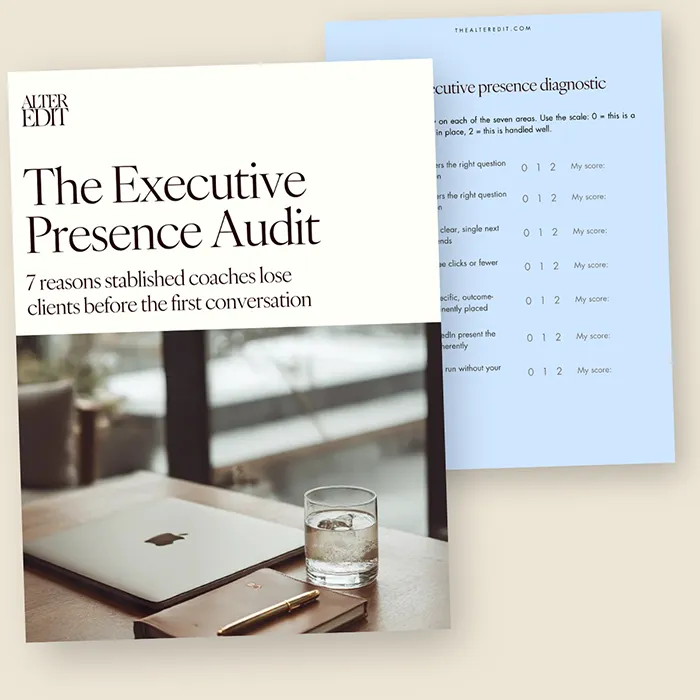
The Executive Presence Audit was designed specifically for this evaluation. It covers seven areas of digital presence, including visual consistency and platform coherence, with a structured self-assessment framework that surfaces specific gaps and helps you understand the order in which to address them. Download the Executive Presence Audit here.
Brand inconsistency is not a personal failing and it is not a sign that you do not take your business seriously. It is what happens when a business grows without a system to hold its presentation together. The gap between the quality of your work and the coherence of how you present it is a practical problem with a practical solution. The first step is being able to see it clearly.